
By: Pamela Honey
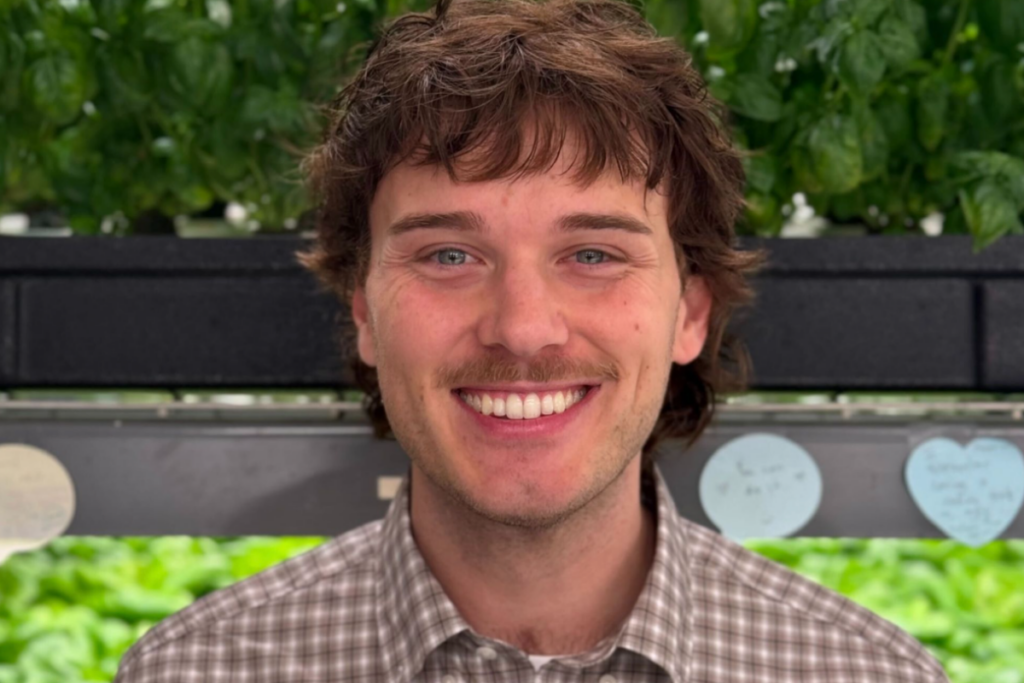
TFFJ Spotlight: Connor Gorsira,
Senior Farm Operations Manager
Teens for Food Justice (TFFJ) builds hydroponic farms inside New York City and Denver Title I public schools. Students grow fresh produce for their school cafeterias and surrounding communities at no cost, building toward local food access, food justice education, and youth leadership.
Nothing gets planted without a plan
Every crop TFFJ grows has a destination lined up weeks before it’s even seeded, and Connor Gorsira, TFFJ’s Senior Farm Operations Manager, is the one who sets it.
This is made possible by TFFJ’s grow-to-order model: each tray is seeded only after confirming its destination, whether it’s the school cafeteria, a take-home bag for a student’s family, or a community partner’s food pantry. Connor keeps these complex schedules in line across eight farms, seven in New York City and one in Denver.
It’s a long way from where he started. Connor majored in neuroscience at the University of Florida, and enjoyed it as a field of study, but a windowless lab wasn’t where he saw himself long-term. “I wanted to be on my feet solving problems, and do work where I could see the results every day,” he said. Food had always been one of his biggest passions, so when a friend told him about the Worldwide Opportunities on Organic Farms program, he was on a plane to Italy two weeks later. The program, known as WWOOF, connects volunteers with organic farms around the world in exchange for manual work and cultural exchange. He spent the next year on organic and permaculture farms across Italy, Spain, the Netherlands, and Ireland, then came home to manage a vegan restaurant in his hometown of St. Petersburg, Florida, followed by a longer stretch managing propagations at a greenhouse in Oregon. From there, Gotham Greens hired him as greenhouse supervisor for a 20,000-square-foot rooftop hydroponic operation in Gowanus, Brooklyn, that specialized in basil.
Trading basil expertise for a broader harvest
At Gotham Greens, Connor considered himself a basil expert. Three years in, he realized he wanted work that combined his love of food and hydroponics with something more meaningful. He found TFFJ, which asked for more: Swiss chard, cilantro, bok choy, radishes, cucumbers, turnips, or whatever crops students wanted to cook with in class. He had to broaden his own knowledge of hydroponic production, learn to spot quality issues across dozens of crops instead of one, and build growing schedules from scratch. All of that had to happen inside buildings that were never designed for farming. “The farm came second,” he said. “The school was built first, and then TFFJ arrived to put a farm in there, rather than the other way around.” That means working around infrastructure that’s often a century old, and around each school’s own maintenance schedule, which can sometimes limit farm access during school breaks.
Running eight farms across two cities
Food safety comes first. Connor ensures handwashing procedures and good agricultural and manufacturing practices at every farm. Staff and students never make bare-hand contact with produce, seeds, grow plugs, or packing materials, and single-use gloves are standard whenever food is handled. From there, his job is crop scheduling: deciding what gets grown, and when, so it’s ready the moment its intended recipient needs it. Since he can’t be on-site at every farm every day, he relies on TFFJ’s farm management dashboard, co-built alongside Ezra Orlinsky, the Far Rockaway Assistant Farm Operations Manager. It runs checklists, tracks inventory, and holds training resources, letting Connor manage all eight farms remotely, while splitting his in-person time between the farms located in the Bronx and Manhattan, training staff and supporting harvesting, packing, and crop management.
Where automation ends, and student learning begins
Every TFFJ farm is fully integrated with its school, though no two look quite the same. Each one takes shape around what that specific school needs. Connor points to a few consistent markers of that integration: students leading farm projects and shaping project-based learning, school staff running day-to-day operations, and outcomes that support both the school’s educational and food production goals.
But not every task runs on its own. TFFJ’s systems automate reservoir refills, nutrient dosing, and pH balancing, but seeding, harvesting, and transplanting still need people. That’s where students step in, and Connor sees it as a chance for them to learn both sides of the system: what the automation handles, and where their own hands take over. “Students get the opportunity to actually engage with the systems manually,” he said. In experimental grow systems, that manual engagement goes even further. Students measure and add their own nutrient solution, take readings, and form hypotheses about plant response, seeing directly what runs on its own everywhere else on the farm.
Catching problems before they spread
Farmer-Educators inspect crops daily as part of a standard checklist. If they identify a pest, they file a report through the farm dashboard, which includes a reference gallery of common pests with images and background information. The report automatically alerts Connor.
TFFJ’s Integrated Pest Management (IPM) approach starts with prevention, such as closing windows and other entry points. If pests are already present, the next step is introducing beneficial insects, including ladybugs and lacewing larvae, both natural predators of aphids and other common pests. “Early detection is key,” Connor said, “and early intervention is the best way to support eradication of the pest.”
If beneficial insects don’t resolve the issue, TFFJ turns to OMRI-listed organic pest control products as an added precaution. These products are derived from botanical extracts, beneficial fungi, or naturally occurring microorganisms, ensuring safe, high-quality produce for our youth.
The recipe behind every harvest
For Connor, food justice means making fresh produce something students want to eat, not something they feel obligated to eat. Hydroponic growing helps make that case, since crops are often harvested the same day they reach a plate. That freshness isn’t left to chance. Connor calls the full set of decisions behind every crop from seed count and days from seed to harvest to nutrient formula and hours of light, a “grow recipe,” worked out before a single seed is planted, so the same quality can be produced reliably every time.
That same care follows the produce home. Campus distributions come with recipe cards students have tested themselves, so families know exactly what to do with what they’re given. There is an immense amount of planning and attention to detail behind every head of lettuce TFFJ grows, all so students can have access to the best produce and the best experience the farm can offer.❦
Pamela Honey is the Communications & Content Coordinator at Teens for Food Justice.