
By: Pamela Honey
The Math Behind Every Growing Cycle
Teens for Food Justice (TFFJ) plants more seeds than its hydroponic systems will ever hold, and that’s not a mistake; it’s by design. Every crop at TFFJ starts as a seed, never a purchased seedling, so each growing cycle produces a predictable surplus, sometimes as high as 15 percent, of healthy seedlings ready to grow.
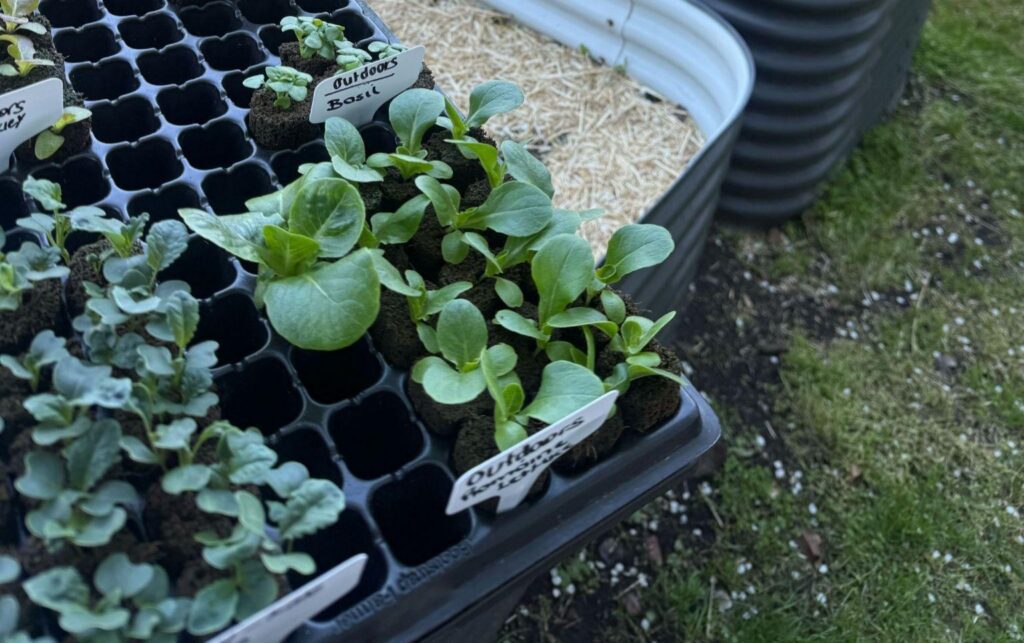
At the time of transplant, Farmer-Educators and TFFJ student farmers select the strongest seedlings for TFFJ’s hydroponic systems: the healthiest sprouts, the ideal number of sprouts per grow plug, and plugs free of the shape or depth defects that sometimes come from the manufacturer.
Selecting the strongest seedlings doesn’t mean the rest are unviable. It means that because TFFJ’s systems only hold so many plants, the strongest ones get first place in line. Everything else is still healthy. It just needs somewhere else to go.
The First Stop: A Food Pantry in the Bronx
TFFJ’s largest seedling donation partner is Kingsbridge Heights Community Center (KHCC), which runs a food pantry and already picks up bagged, harvested produce from the TFFJ farm at the Dewitt Clinton Educational Campus (Clinton) every week. TFFJ started sending along a tray of extra seedlings on those same pickups. Last year, those trays added up to 7,186 seedlings for KHCC’s own community garden and in support of its food justice, nutrition, and youth gardening education programs.
The trays themselves get reused. KHCC returns each empty tray on its next pickup, and TFFJ hands over a freshly grown one in exchange. No plastic gets thrown away.
Grown for the Plate, Grown for the Beds
Some seedlings never leave the farm. At this early stage of growth, they’re essentially microgreens: tender and nutrient dense. Farmer-Educators and students harvest the healthiest leaves, like baby arugula, basil, collard greens, and baby bok choy, then turn them into what staff calls a seedling salad, served on its own or as a sandwich topper.
Others go outside. TFFJ transplants seedlings to outdoor raised beds where space allows, including the beds at the main entrance of Martin Luther King, Jr. Educational Campus (MLK). Marigolds are the most common flower in those beds, originally grown not for their looks but because they’re edible: students request them for tea. Left to bloom instead of being harvested, the surplus blooms give students a beautiful wash of orange to walk past every morning on their way into school.
When a Seedling Doesn’t Meet Requirements
To account for seeds that fail to sprout, TFFJ oversows by 10 to 13 percent, depending on the crop. Romaine lettuce germinates reliably and needs a smaller cushion, while cilantro and parsley germinate less predictably and get a higher one.
A grow plug with a manufacturing defect can sit too shallowly to reach the nutrient water, so the seedling dries out before it has a chance to grow. Other seeds simply don’t germinate at all. Crops like basil, arugula, cilantro, and collard greens need multiple sprouts per plug to produce a full-size yield, and when one of those plugs germinates only a single sprout, the plant can still grow well on its own. It just won’t meet the production requirements for a spot in a TFFJ hydroponic farm.
Those seedlings are composted instead, which raises a problem most TFFJ school sites share: they don’t compost on-site. New York City’s Comptroller found that food scraps make up about a third of school waste citywide, but schools capture only 37 percent of that for composting.
A Second Life in Compost
At Murry Bergtraum Educational Campus (Murry), Farmer-Educator Francesca W. found a way to compost the farm’s waste despite the lack of an on-site composting program. She partnered with Assistant Professor Perl Egendorf, who runs the garden at nearby Pace University, and began sending the farm’s compostable waste to the garden instead of into the trash. Then she added an extra step of her own: breaking down leftover grow plugs and seedlings by hand with her students, so the material composts faster once it reaches Pace.
The additional step is effective because of the growing medium TFFJ chooses in the first place. TFFJ uses coconut coir grow plugs instead of rockwool, a common hydroponic substrate that doesn’t break down easily. Coconut coir, however, is compostable, so even the seedlings that never get planted can still return nutrients to the soil.
A tray of seedlings can end up in a hydroponic system, a community garden, a compost pile, or a salad bowl. Ask a Farmer-Educator which one, and the answer is often all of the above. Just like the food we grow, each and every one lands somewhere it’s needed.❦
Pamela Honey is the Communications and Content Coordinator at Teens For Food Justice.