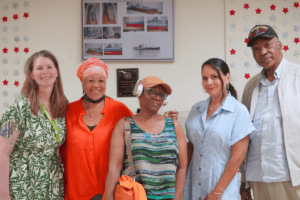

Photo by Max Feliz P., 12th-grade student from LACJ
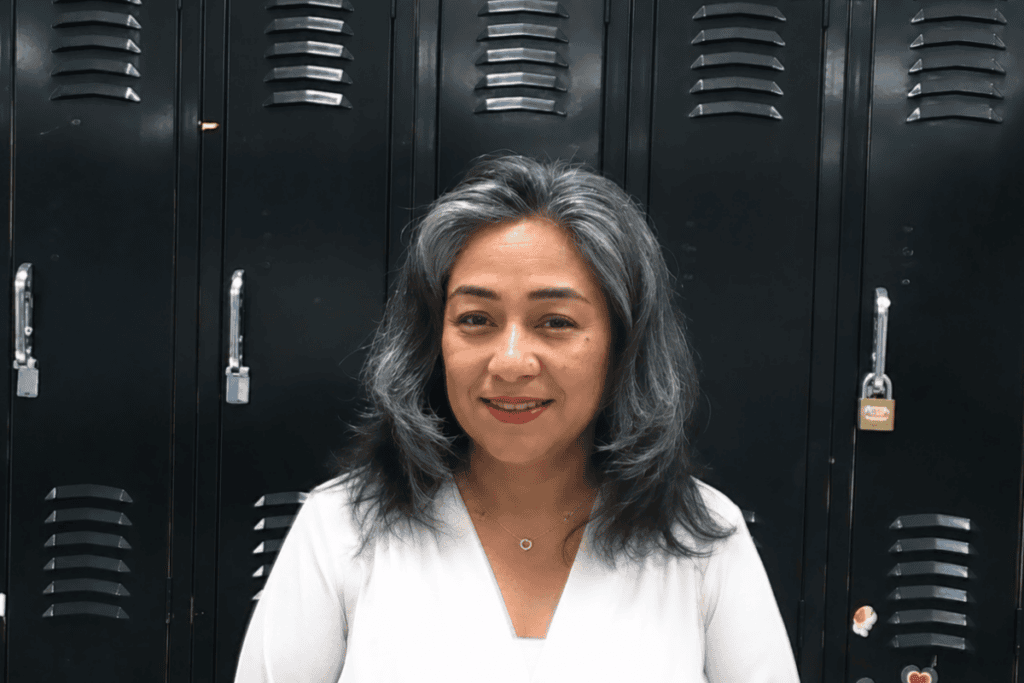
TFFJ Spotlight: Claudia Reyes, coordinadora de padres
Por: Pamela Honey
English version below.
Cada recorrido escolar que Claudia Reyes guía en la High School for Law, Advocacy and Community Justice (LACJ) termina en la granja hidropónica.
LACJ es una de las escuelas que comparten el Martin Luther King Jr. Educational Campus. Reyes es la coordinadora de padres de la escuela desde 2021, y guía los recorridos para los estudiantes que ingresan a noveno grado y sus familias. “Yo siempre, siempre, siempre, la última parada antes de que la familia se vaya es llevarlos al hydroponic farm“, dice Reyes. “Eso no faltaba en el tour. Eso era lo último, pero eso era el grand finale“.
Todo empezó con una pregunta
Reyes descubrió la granja hidropónica por curiosidad. “Yo me di cuenta que teníamos la finca hidropónica en el edificio y me puse a preguntar qué era lo que estaba pasando aquí”, cuenta. “Me dio una curiosidad viendo que había verduras. Entonces yo entré, pregunté y pues me dijeron: ‘Esto es lo que tenemos, esto es lo que estamos ofreciendo’.”
El personal de Teens for Food Justice (TFFJ) le explicó cómo la cafetería utiliza las verduras cosechadas. También supo que TFFJ dona el resto de la producción mediante distribuciones cada dos semanas a la comunidad escolar y a un banco de alimentos al otro lado de la calle. “Vi eso como algo muy positivo”, dice Reyes, “y algo en lo que yo quería participar”.
Su primer paso fue una colaboración con la entonces maestra de arte de la escuela, la Sra. Erica Yonks, quien dirigía un Club de Hidroponía con TFFJ. Juntas crearon un proyecto en el que los estudiantes aprendieron a cosechar, cortar y preparar las verduras para una ensalada, y lo documentaron en video para compartirlo con las familias a través de las redes sociales oficiales de Reyes como coordinadora de padres. Ese video, grabado en abril de 2022, fue solo el comienzo.
Cómo Reyes corrió la voz
Reyes dice que empezó a trabajar todavía más de cerca con TFFJ cuando llegó Alyssa Gardner-Vazquez, entonces Agricultora-Educadora Sénior en la granja del MLK Jr. Educational Campus y hoy Coordinadora Regional Sénior de Brooklyn Bridge.
“Yo creo que la señorita Alyssa, Miss Gardner, hizo una diferencia inmensa”, dice. “Ella tenía ideas de cosas que podíamos hacer en la finca”. Gardner-Vazquez y Yonks pidieron a los estudiantes que hicieran postales con una foto de la verdura y su receta al reverso. Las clases semanales de Gardner-Vazquez en la granja y las distribuciones de productos le dieron a TFFJ una presencia constante en la escuela. “Nosotros veíamos la presencia de TFFJ en el lobby principal o si no, se paraban afuera cuando se permitió, y ellos daban las bolsas de verdura”, dice Reyes. “Presencia, ¿verdad? Había más visibilidad”.
Reyes aprovechó esa visibilidad a su manera. Publicó videos y fotos de la granja en las redes sociales de la escuela, y en los recorridos les entregaba postales a los padres y les pedía que se inscribieran en la distribución. “Con los postcards que teníamos, entonces era fácil”, dice. También les recuerda a las familias que visitan que la distribución es gratuita y para la comunidad. Reyes sigue usando sus propios canales para decirles a las familias que la granja también es para ellas.
En su boletín para las familias de LACJ, Reyes promueve las distribuciones de productos cultivados por estudiantes y el Club de Hidroponía.
Cuando TFFJ distribuyó callaloo en LACJ, varias personas de la escuela con raíces caribeñas lo reconocieron de inmediato. “Eso fue un momento también emocionante”, dice Reyes. “Decían: ‘Oye, tienen callaloo, eso es comida caribeña. Hay que llevarnos una bolsa'”.
Un momento de esperanza
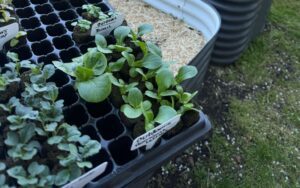
El año escolar pasado, Reyes organizó una reunión con las familias en la granja, y Gardner-Vazquez preparó estaciones interactivas, entre ellas una con tapones de cultivo (grow plugs), donde la semilla se coloca dentro del recipiente antes del trasplante. Una familia llegó con su hija de 6 años, la hermana menor de un estudiante de LACJ.
“Esa niña estaba tan entusiasmada, tan involucrada, enfocada en eso”, recuerda Reyes. “Cuando le dieron los guantes, ella, de una manera concentrada, ese momento a mí me dio como una esperanza del futuro. Esta es una memoria, core memory, para esa niña”. Reyes agrega que la mamá también estaba feliz de ver a su niña tan concentrada.
El peso de cargar la bolsa
Reyes habla con franqueza sobre los obstáculos que ve. “El cargar la bolsa, por ejemplo, es uno de ellos”, dice, “para acceder a estos productos”. Los horarios y las responsabilidades familiares limitan cuánto pueden participar los padres en persona, y no todos los estudiantes quieren cargar con una bolsa de verduras.
Aun así, Reyes quiere que el programa siga creciendo, y reconoce lo que ya funciona. “Creo que la granja está haciendo un gran trabajo al ofrecer una variedad de verduras, porque no siempre es lo mismo”, dice. Lo que le gustaría ver crecer es la posibilidad de realizar más reuniones de padres en la granja y aumentar la participación estudiantil en el Club de Hidroponía.
Más allá de la escuela, el mensaje de Reyes es sencillo. “Quiero que la gente entienda lo importante que es aprender a cultivar nuestros propios alimentos”, dice. ❦
Pamela Honey es la Coordinadora de Comunicaciones y Contenido de Teens for Food Justice.
TFFJ Spotlight: Claudia Reyes, Parent Coordinator
By: Pamela Honey
Every school tour Claudia Reyes gives at the High School for Law, Advocacy and Community Justice (LACJ) ends at the hydroponic farm.
LACJ is one of the co-located schools within the Martin Luther King Jr. Educational Campus. Reyes has been the school’s parent coordinator since 2021, and she leads tours for incoming ninth graders and their families. “Always, always, always, the last stop before a family leaves is the hydroponic farm,” Reyes says. “That’s never missing from the tour. It’s the last thing, but it’s the grand finale.”
It Started with a Question
Reyes found the hydroponic farm out of curiosity. “I noticed we had a hydroponic farm in the building and I started asking what was going on here,” she says. “I was curious seeing there were vegetables. So, I went in, asked, and they told me: ‘This is what we have, this is what we’re offering.’”
Staff from Teens for Food Justice (TFFJ) explained how the cafeteria uses the harvested vegetables. She also learned how TFFJ donates the rest of the produce through distributions every two weeks to the school community and to a food pantry across the street. “I saw that as something very positive,” Reyes says, “something I wanted to be part of.”
Her first step was a collaboration with the school’s art teacher at the time, Ms. Erica Yonks, who ran a Hydroponics Club with TFFJ. Together, they built a project where students learned to harvest, cut, and prepare the vegetables for a salad, and documented it on video to share with families through Reyes’s official social media as parent coordinator. That video, recorded in April 2022, was only the start.
How Reyes Spread the Word
Reyes says she worked even more closely with TFFJ once Alyssa Gardner-Vazquez, then Senior Farmer-Educator at the MLK Jr. Educational Campus farm and now Brooklyn Bridge Senior Regional Coordinator, arrived.
“I think Miss Alyssa made an immense difference,” she says. “She had ideas for things we could do on the farm.” Gardner-Vazquez and Yonks had students make postcards pairing a photo of the vegetable with its recipe on the back. Gardner-Vazquez’s weekly classes on the farm and the produce distributions gave TFFJ a constant presence at the school. “We would see TFFJ’s presence in the main lobby, or if not, they’d stand outside when it was allowed and hand out the produce bags,” Reyes says. “That’s presence. There was more visibility.”
Reyes built on that visibility in her own way. She posted videos and photos of the farm on the school’s social media, and on tours she handed parents postcards and asked them to sign up for the distribution. “With the postcards we had, it was easy,” she says. She also reminds visiting families that the distribution is free and open to the community. Reyes keeps using her own channels to tell families the farm is for them too.
In her newsletter to LACJ families, Reyes promotes student-grown produce distributions and the Hydroponics Club.
When TFFJ distributed callaloo at LACJ, several people at the school with Caribbean roots recognized it right away. “That was a moving moment,” Reyes says. “They said, ‘Hey, they have callaloo. That’s Caribbean food. Let’s grab a bag!’”
A Moment of Hope
Reyes hosted a family event on the farm last school year with Yonks, and Gardner-Vazquez set up interactive activities, including one with grow plugs, where the seed goes inside the container before transplanting. One family came with their 6-year-old daughter, the younger sister of an LACJ student.
“That girl was so eager, so focused on it,” Reyes remembers. “When they gave her the gloves, and she placed the seeds with so much concentration, that moment gave me hope for the future. This is a core memory for that girl.” Reyes adds that the mother was also happy to see her daughter so focused.
The Weight of Carrying the Bag
Reyes is direct about the obstacles she sees. “Carrying the bag is one of the obstacles to accessing these products,” she says. Schedules and family responsibilities limit how much parents can participate in person, and not every student wants to carry a bag of vegetables home.
Even so, Reyes wants the program to keep growing, and she recognizes what’s already working. “I think the farm is doing a great job providing a variety of vegetables, because it’s not always the same thing,” she says. What she’d like to see grow is the ability to hold more parent meetings on the farm, and more student participation in the Hydroponics Club.
Beyond the school, Reyes’s message is simple. “I want people to understand how important it is that we learn how to grow our own food,” she says. ❦
Pamela Honey is the Communications & Content Coordinator at Teens for Food Justice.