
TFFJ Spotlight: Jessenia Preciado, TFFJ’s Far Rockaway Regional Manager
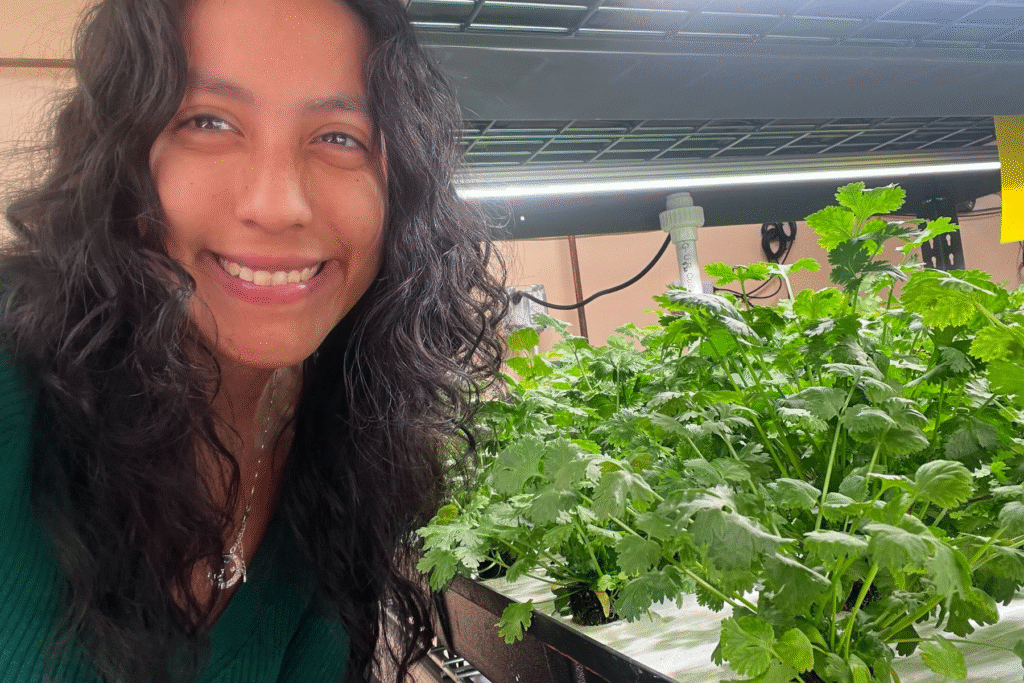
As Far Rockaway Regional Manager, Jessenia Preciado works across schools, classrooms, and community spaces to support student leadership, strengthen partnerships, and expand food access across the Far Rockaway peninsula in South Queens. Her role sits at the intersection of education, food justice, and community coordination, grounded in long-term relationships built on listening and trust.
Jessenia moves between school leadership meetings and community spaces, ensuring programs remain responsive to students and schools in real time. On any given day, she might meet with administrators about farm operations or attend a community meeting on local policy. “Our students are leaders,” she says. “My role is to make sure they have opportunities to grow, and that the adults around them feel connected to the work, too.”
“Our students are leaders. My role is to make sure they have opportunities to grow, and that the adults around them feel connected to the work, too.”
Leadership Rooted in Experience
Jessenia grew up in Ecuador, surrounded by rich plant life and family traditions that emphasized respect for food and the land. She moved to the United States when she was 10 years old and entered middle school without speaking English. She remembers sitting in classrooms and not understanding what was being said, navigating a new culture and language at the same time. Both experiences continue to shape how she leads today.
When reflecting on her work, Jessenia often returns to one theme: how students in New York City think about nature. She often hears students say that living in a dense city makes them feel disconnected from it: “Living in New York City, nature and I are separate because I’m in New York City. I’m not interacting as much with nature.” Her response is direct: “But you are. You are interacting with nature every day.” For her, the hydroponic farm is proof of that. Many start to realize, “I don’t have a backyard, but I can still grow something,” and begin to see themselves as participants in food systems rather than outsiders passively affected by those systems.
That same instinct to meet people where they are carries over into how she builds partnerships. In her classroom and beyond, she builds in clarity and structure so students know what is expected of them and why. She creates multiple entry points for participation, especially for students who may be navigating a new language or unfamiliar systems. Rather than assuming confidence or prior knowledge, she gives students time to observe, ask questions, and step into leadership at their own pace. In her work with families and community partners, she prioritizes clear communication, knowing that trust develops through consistency.
Showing Up Across the Rockaway Peninsula
The challenges of food access across Far Rockaway directly influence how TFFJ programs are designed and delivered. Residents face limited grocery options and inconsistent access to fresh produce. In this context, school-based farms serve not only as learning environments but also as reliable sources of fresh vegetables for students and families. Jessenia explains that “[The Farm] may be one of the few places students can consistently access healthy produce,” and that responsibility “guides how we grow, what we grow, and when we distribute food.”
“[The Farm] may be one of the few places students can consistently access healthy produce.”
Through community events and meetings with local organizations and elected officials, Jessenia builds trust by being present. She listens, follows up, and stays connected. “It’s important to listen and try to talk to as many community members as possible because they’re the ones who really understand what’s going on around them.” That same approach carries into the farm learning space.
Centering Student Leadership
Just as she listens to community members, she listens to students. Creating stable learning environments is central to this work. In TFFJ farms, clear structure and consistency help students feel comfortable participating and taking ownership of the space. Jessenia emphasizes that “we want students to walk in knowing what they’re doing and why.” Students are always asked what else they would like to do at the farm, reflecting TFFJ’s foundational belief, as Jessenia mentioned, that “they’re the leaders of the farm.”
Those conversations shape programming and reinforce student leadership, with educators acting as guides and resources. Jessenia views this approach as foundational to building confidence and trust, allowing students to take on new responsibilities and see themselves as leaders both on the farm and beyond.
When Students Shape the Harvest
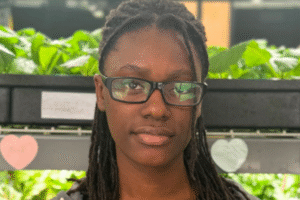
Student leadership often shapes what happens on the farm itself. While working as a paid intern through her school’s co-op program, high school student Ambreal noticed that many families receiving food distributions shared her own Caribbean cultural roots, observing that “a lot of our community members are coming from the same countries.” She created a survey to learn which produce community members most wanted, then proposed growing callaloo as a way to serve them with more culturally appropriate food.
As a result, student farmers began callaloo crop tests on the farm at the Far Rockaway Educational Campus. They were successful, and today, callaloo is grown across TFFJ farms in New York City. When reflecting on this student-led initiative, Jessenia is clear about where the credit belongs: “That was all [Ambreal].”
Connecting The Far Rockaway Farm Hub
Jessenia’s work as the Far Rockaway Regional Manager is to connect TFFJ’s work at five campuses and ten schools across the peninsula, ensuring that farms operate consistently and that programming remains aligned. Some campuses host multiple co-located schools. Some are still preparing to launch new farms. All require clear communication and follow-through.
She describes the farm hub as “a community.” At first, she made the introductions. Over time, she watched those relationships continue without her prompting.
Across campuses, the farm programs are connected. Student leadership extends across campuses, educators see their work as part of a shared effort to expand food access across the Rockaway Peninsula, and the coordination behind it allows that work to continue year after year. The infrastructure supports tens of thousands of pounds of fresh produce grown and distributed each year.
But for Jessenia, success isn’t just about outputs. It shows up in smaller moments. She describes moments when a student notices “the difference between the red oak leaf lettuce we grow and what they see at the deli,” and begins asking, “what kind of research project can I work on to understand that?”It appears when students try new foods at school and recreate those recipes at home. Jessenia often hears students say, “I made that recipe at home,” and for her, “that always feels really great.”
Another marker is adult buy-in. Jessenia describes moments when educators go from not knowing hydroponics or TFFJ to saying, “This program is amazing,” and feeling excited to see what students are learning and growing.
These moments point to something long-lasting. The farm doesn’t just change what students eat or grow. When students return to the farm time and time again, take on new responsibilities, and bring what they’ve grown into their home kitchens, it’s clear that something has shifted. For Jessenia, these moments show that a larger shift is taking place for both students and schools: students whose relationship to food has changed, and schools whose culture has changed along with it. ❦
Pamela Honey is the Communications & Content Coordinator at Teens For Food Justice.