
By: Emily Miller
TFFJ Receives $100,000 Innovation Grant from Impact 100 NYC
Funding will expand farm-based programming to students with disabilities across New York City.
Teens for Food Justice has been awarded a $100,000 Innovation Grant and a $10,000 Operating Grant from Impact 100 NYC to expand its farm-based programming for students with disabilities. The two-year project, launching in July 2026, will adapt TFFJ’s curriculum, train educators in inclusive instruction, and equip all seven of its New York City farms to serve a fuller range of learners.
“We will embed accessibility into the DNA of our farms,” said Dr. Meghan Groome, CEO of Teens for Food Justice. “Not as an accommodation, not as an afterthought, but as the standard. Every farm. Every lesson. Every student.”
Nearly one in four students across TFFJ’s 24 partner schools is classified as having a disability. Most have not been able to access farm-based experiential learning, particularly students served by District 75, New York City’s specialized school division, whose programs require scheduling, staffing, and instructional approaches that TFFJ’s current model does not yet fully support.
The gap is a sharp one. The multi-sensory, active, project-based environment of a hydroponic farm is precisely the kind of setting where students with disabilities often do their best learning.
“The irony at the center of this project,” said Dr. Groome, “is that the learning environment that best supports these students is the one they currently have the least access to.”
This project is designed to remove the barriers standing between those students and that environment.
For Every Student
The project is centered around three core elements: training educators, adapting curriculum, and equipping the farms.
TFFJ staff will receive specialized training in inclusive instruction, so they feel capable and confident working with students across a wide range of needs. The Hydroponics 101 curriculum will be redesigned using Universal Design for Learning principles, making it more responsive to different learning styles from the start, not as a workaround. And the farms themselves will get new tools and equipment so that the physical work of growing food is accessible to more students.
The goal is not a separate program for students with disabilities. It is one program, built for everyone, that reaches more than 700 students with disabilities across New York City in the first two years alone.
It Started With Just Two
Last year, an occupational therapist at Martin Luther King, Jr. Educational Campus brought two students with disabilities to the TFFJ farm for weekly sessions, drawing on the farm’s strengths as a learning environment: crop harvesting, sequencing, fine motor development, and confidence-building.
Week by week, those students grew in their understanding of the farm and its systems. Near the end of the school year, they led a culinary activity using farm-grown ingredients. A teacher invited more students to join. What began as two participants became twelve. The original students stepped naturally into teaching roles, explaining harvesting techniques and demonstrating how the farm works.
They also led a plant painting project connected to the school’s Student Leadership Conference, sharing their knowledge with the broader campus community.
Food justice means access for everyone. Students with disabilities deserve to grow food, lead on the farm, and contribute to the communities around them. Not as observers. As leaders.
Funding for the “Designing Accessible Hydroponic Farm Education for Students with Diverse Needs” provided by Impact 100 NYC, Inc. The views expressed herein are solely those of Teens for Food Justice and are not intended to represent those of Impact 100 NYC, Inc.
About Impact 100 NYC
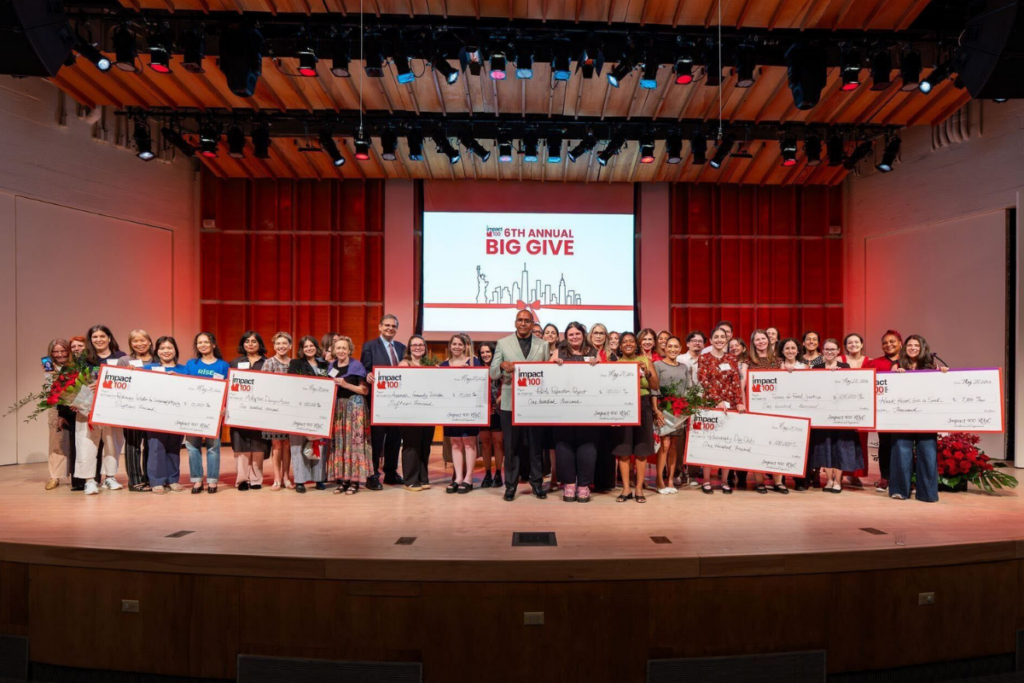
Impact 100 NYC is an all-women, all-volunteer giving circle founded in 2020. Its 470 members each contribute $1,000 annually, and the pooled funds are awarded as high-impact grants to New York City nonprofits. The grant to TFFJ was announced at Impact 100 NYC’s annual Big Give event on May 20 at Merkin Hall at the Kaufman Music Center. Since launching, Impact 100 NYC has awarded more than $2 million to 24 organizations across the five boroughs. It is a chapter of Impact100 Global, which has collectively granted more than $178 million to local communities across more than 80 chapters in four countries.
About Teens for Food Justice
Teens for Food Justice builds and operates youth-led hydroponic farms in Title I schools across New York City, producing fresh food for students, families, and communities while training young people in food justice, STEM, and advocacy. Learn more at teensforfoodjustice.org.❦
Emily Miller is the Director of Development & Communications at Teens For Food Justice.